Your Braveheart Questions & Answers
|
|
Your Braveheart Questions & Answers |
|
Braveheart questions
(and answers) here from:
|
 email us your BH questions and answers |
Woodbine Farm ...
Q. I'm
writing a book about recent historical films, and a detailed look at Braveheart - one of
my favourite films - will be an important part of it. I'm really impressed by your site -
it's by far the best movie-related site I've ever visited. The Q&A section is
excellent... and I wonder if I could
take advantage of it to settle a matter that's been puzzling me?
In the film Longshanks declares he is going to 'breed out' the Scots by introducing the
ancient English custom of prima nocte, giving noblemen the right to sleep with the bride
on the night of a tenant's marriage.
Does anyone know whether there was such a custom and whether it was introduced in Scotland
in the late 14thC (or indeed, was it being practiced by Scots nobles already?). Any ideas
would be gratefully received.
A. We understand that there is no evidence to indicate that the feudal right of 'jus primae noctis', where the Lord has one night of sexual access to a newly married tenant, was operated in Scotland at the time of the Wars of Independence. The introduction of this aspect of feudalism into the movie script was purely for dramatic reasons.
Nick Antonioy ...
Q. I AM
NICK ANTONIOY FROM GREECE. I AND MY FRIEND HAVE SEEN MANY TIMES THE MOVIE AND WE HAVE
BECOME GREAT FANS OF BRAVEHEART, AND WE TRY TO FIND ANY INFORMATION WE CAN.
WE WOULD LIKE TO KNOW WHAT HAPPENED BETWEEN THE YEAR OF WILLIAM WALLACE'S DEATH AND 1314?
A. In real history, as opposed to the dramatised story in the movie, the years 1305 (when Wallace was executed) to 1314 (Battle of Bannockburn) saw Robert the Bruce take the crown of Scotland (in 1306), after killing his rival John Comyn at the church of the Minorite friars in Dumfries. Edward I (Longshanks), needless to say, was not pleased about this, and newly-crowned Robert was soon on the run in the West Highlands and then Northern Ireland, two of his brothers caught and executed, his wife and daughter imprisoned. He returned in February 1307 and began to have some success in regaining his kingdom from the occupying English forces. This was helped by Longshank's death in July 1307. Edward II was no 'Hammer of the Scots' as his father had been and, although war continued between England and Scotland, the Bruce and his supporters gained the upper hand more and more. The challenge (issued perhaps foolishly by Robert's brother Edward Bruce) to the English to relieve the Scots siege on Stirling Castle by midsummer 1314 (or give up the castle) precipitated the Battle of Bannockburn, which at last freed Scotland, and allowed Robert to ransom back his wife and daughter. This did not put an end to the fighting entirely, and it took until 1328, a year before his death, for Robert to see a treaty signed with England accepting Scotland's independence.
Sarah Johnson ...
Q. Hi.
I was just wondring if there is any link I could go to to see pictures of James Robinson
(young William)? I have tried many times but I never got any pictures of him.
Thanx so much. if u could tell me I would appreciate it so much.
A. James came to the 1997 Braveheart Convention We have pictures of James on our page with messages from the convention.
Noor Faizah ...
Q. I've been to every Braveheart website and some said that the character Murron was made up. There's no one named Murron in the actual life of Sir William. Is that true?
A. What is known about William Wallace indicates that he was married to Marion Braidfute of Lamington. The wife of the Braveheart Wallace character was called 'Marion' in Randall Wallace's original screenplay. We believe it was subsequently changed to 'Murron' to avoid confusion with the Marion in the Robin Hood story (as in Kevin Costner's Prince of Thieves movie).
Lee Norman ...
Q. If you know, what is an "amadon" as referred to by the neighboring MacGregor clansmen?
A. In the original screenplay 'Amadans' is not mentioned:
|
MACGREGOR We heard about what was happenin'. And we don't want ya thinkin' ya can have your fun without us. |
The Amadan are Irish faerie fools. Maybe some of the Irish actors involved in the Glen Nevis area filming suggested using this word, and that is how it got inserted into the dialogue. Find out more about Fool of the Forth, Amadan-na-Briona, and other faeries at the Faeries website.
Mike Anderson ...
Q. What is the
historical significance of the thistle becoming the national
flower of scotland?
A.
Click here  to find out about the thistle.
Jannike ...
Q. I'm wondering what tartan everyone is wearing in Williams village? The
brownish one. It can't be the Wallace clan tartan, can it?
Please answer me personally or on the FAQ. page. I really have to know this now!!! And
does anyone know what the wife who had to sleep with the englishman is called?
Regards
Jannike :-)
A.
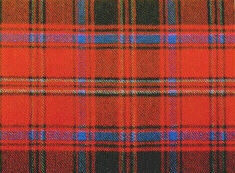
The tartans used were specially developed for the
movie.
The actress who played the wife in the village wedding scene was Julie Austin, you can see
photographs of her on some of the 1997 Braveheart Convention
pages.
Richard & Kim Clark ...
Q. I have just been exploring the web and found your site, it is good that
someone has made a site for this brilliant film.
I have been to Scotland many times on holiday. I heard of Robert the Bruce long ago, and
I've stood inside the cave that is believed to be where he hid for many months watching
the spider, but I never heard of William Wallace.
During the eighties, the best film I saw was Highlander, and a few years after I saw it I
had to go up there and see the places it was made. It's a shame what they did in the
sequels to that film, I don't think the producers realised that by dropping the
soundtrack, Queen's music and the scenery, the
following films would be unsuccessful.
In 1994, I took my wife up to see Scotland - it was the first time she had been to
Scotland, and she wanted to see the sites used in Highlander. While we were staying in
Fort William, we asked the people we stayed with about the sites, and she told us a new
film was being mad in the glen - Braveheart. Kim and I were up there straight away, it was
raining but we saw the beginning of the film being made (with the nobles and their pages
riding to McAndrew's Barn). I took photos of the village, and some of the characters. When
the film came out at the cinema, Kim and I were first to see it, and we noticed at the
beginning, you can see a white car go up the mountain in the distance, as the nobles are
riding down the hill - our car is white but it is very difficult to tell if it is ours.
We watched both Braveheart and Rob Roy, bought the videos, books and soundtracks. I
thought both films were excellent, however my wife isn't too keen on Rob Roy, I believe
this is to do with the rape scene, Rob Roy cutting the insides out of the rotting cow, and
watching Cunningham being sliced in half at the end, but I think the story, soundtrack and
scenery make up for these.
Hopefully, one day we will be able to afford to travel to Scotland again (depending on
what Mr Brown announces about petrol prices next year), and we would like to see Stirling,
as well as the film sites. The book of the film Braveheart is much longer than the film -
is there any chance of there being a "Special Edition" of the film (like Star
Wars, T2 & Aliens) showing Wallace going to France and Rome to get help?
The part of the film we liked the best, was the battle of Stirling. I assume this is
probably everyone's favorite part. The only thing missing of course, was the river.
According to the book, Wallace allowed the English to partially assemble on the northern
side of the bridge, then he charged, which is similar to how Hannibal defeated the Romans,
by surrounding them, giving them no room to fight. In the film however, there was no
river, and it does look strange that the Scots were outnumbered before the fight.
Another question, when Wallace was knighted, a noble called Balliol walked up to him and
asked him to support his claim to the throne. Who exactly was this Balliol? I though the
leader of the Balliols was in the Tower of London after refusing to pay homage to
Longshanks.
Anyway to answer one of your questions, I must have seen the film at least 30 times, and
haven't become tired of it yet. Is there any chance of a sequel to the film, showing
Robert the Bruce leading the Scots to freedom?
Braveheart appears to have left the ending open for a sequel.
Richard & Kim Clark
A. So many questions. Some answers/thoughts ...
Following on from the accidental death of King Alexander
III of Scotland in 1286, and the subsequent death of the Maid of Norway, the Scottish
nobles stupidly asked Longshanks to help them chose a new king from the various claimants.
Longshanks chose John Balliol. Balliol was indeed being held in England (since July 1296)
at the time of the events portrayed in Braveheart. The movie
makers used a bit of artistic licence here as elsewhere.
As regards a sequel to Braveheart, the most likely outcome would
be for a movie to be made of the life of Robert the Bruce, probably based on the excellent
Nigel Tranter book (trilogy). Mel Gibson could direct this one without having to star in
it too. We are only five years away from the 700th anniversary of Wallace's death, and six
years away from the 700th anniversary of Bruce taking the crown (after killing John
Comyn). Time enough to develop a screenplay, put the finance together, film it and release
the movie to tie-in with these anniversaries.
We understand (although we haven't seen it) that the laserdisk version of Braveheart
was longer than the cinema release version (e.g. more lovemaking with the Princess). There
was considerably more footage shot than made it to the final movie, so in theory a
significantly longer version would be possible. We feel however that the decisions taken
to make the cuts (taking the running time down to 3 hours) were for the best, from a
dramatic point of view, although it does leave a number of occasions where characters are
saying dialogue which might make better sense had the cuts not taken place e.g. Wallace
talks about hanging women and children from the city walls (which was filmed at Trim
Castle but not included in the movie).
The decision not to have a bridge at the Battle of Stirling (Bridge) was probably taken on
grounds of dramatic effect and cost. Again this was probably the right decision, although
it offended a lot of historical purists. If a more realistic portrayal of the battle had
been attempted, it is doubtful whether it would have been as dramatic, and major
difficulties would have been encountered with the length of the sequence (it would have
tended to be too long).
We too think Rob Roy was an excellent movie.
Anthony Nichols ...
Q. I am looking for a movie on The Bruce . I know it is out there somewhere, because I saw it in a magazine . Thank you for your help.
A. The movie 'The Bruce' was filmed just after Braveheart was released in the UK. It was made with a very low budget. It is a truly terrible movie. Anyone watching it and expecting an experience like Braveheart will be very disappointed.
Chris Jackson ...
Q. Dear Sir or Ma’am,
I have looked high and low and I was hoping that you could help me.
I can’t seem to find anywhere piano scores for any of the music for the soundtrack of
Braveheart. Any information you might have that could lead to me finding them would be
very much appreciated. Thank you very, very much.
Sincerely,
Chris Jackson
A. Anyone able to help?
Petter ...
Q. My name is
Petter, and I'm from Sweden.
Right now I'm doing a schoolwork named : "Braveheart, reality and movie", and I
have a question for you.
How come that Robert the Bruce doesn't speak with Scottish accent?
Would be glad for an answer! Bye bye..
A. Angus McFadyen, who played The Bruce in the movie, spoke with an accent which was fairly neutral, but which did sound "Scottish" to Scottish ears. Setting aside 'The Bruce' character, in Braveheart we had:
Patrick McGoohan (an Irishman) playing an Englishman (Longshanks).
Brendan Gleeson (an Irishman) playing a Scot (Hamish).
David O'Hara (a Scot) playing an Irishman (Stephen of Ireland).
and all played their their parts very well.
In reality, The Bruce was partly descended from Normans (who spoke French) and Celts (who spoke Gaelic) and he probably could speak both of these languages as well as English (as spoken in England where he spent time in his youth) and old Scots (as spoken in lowland Scotland at the time). He would probably also have been been familiar with Latin. Goodness knows what sort of accent he would have had when speaking in each of these languages!
Richard ...
Q. Hello, My name
is Richard
My Favorite character of the movie was..... your right ROBERT
THE BRUCE and I was reading along in your chronology
when suddenly ....... The Bruce Dies??? what how! Who !!??
my question is how did the actual Robert die of??? did someone slay him or did he just die
of age????
A. He died in his bed in Cardross castle. He was almost 55 years old, which was reasonably old for his times. He had suffered illness at various times, and one idea out about is that he had leprosy, and died of this in the end. After his death his wishes were respected, and his heart was taken from his body, out in a casket, and taken on a Crusade by his friend, Sir James Douglas.
Joel Whitmore ...
Q. Hello John and
Linda,
I love the news letter. I was speaking to my brother last week (he's a MA in history)
about finding a copy of the Blind Harry poem.
Thanks a million , you've solved that problem. However, for the last three years I have
been on a quest. I have been trying to find out who the sword smith was on the film.
The person who actually smithed Mel's large claymore. I have three years of dead ends
behind me. I own a replca from Castle Arms and love
it. Could you maybe pass this e-mail around and see if anyone knows who made the swords
(there were 10 according to the production notes) and how I might contact that person ?
sincerely,
Joel Whitmore
A.
We don't know who made the original swords. We'll make some
enquiries. In the meantime, if anyone knows, please let us know.
Janelle ...
| Q. I am a
descendant of John Blair, the comrade of William Wallace, and I have searched
for stories about these men, but all I find is stories of Robert de Bruce, who is also a great
Grandfather, if you have any information on how I might find stories about John
Blair please notify me. It would be greatly appreciated. A. As you mention, John Blair was Wallace's
friend, comrade-in-arms, chaplain, and biographer. Much of what we know about Wallace
we have learned from Blind Harry's
epic poem 'Wallace', which was itself based on John Blair's
earlier biography of Wallace. |
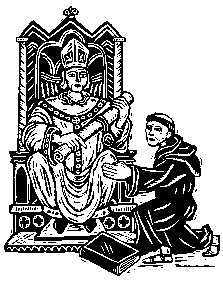 Bishop Sinclair commissions John Blair to write the Biography
of Wallace |
Hugh Sinclair Johnson ...
Q. I'm an Englishman (coming back in May 98) in Australia and I have links through my family history to Stewart of Appin. I was wondering if there is a clan as such or just links with others. A. Sir John Stewart of Lorne was murdered in 1463. Dugald, his son, looked to recover the lordship from his uncle who had taken it. By way of a compromise he was given the lands of Appin. Allan, 3rd of Appin, divided these lands between his five sons and thereby established the Appin clan. |
Stewart of Appin |
William N Greer ...
Q. In her 1986 book "King Arthur," Norma Goodrich presents her
argument for a Scottish King Arthur and references:
1) the 'earliest archives,'
2) George Crawford's "Peerage of Scotland"
3) W.D.H. Sellars' article "The Earliest Campbells" appearing in Scottish
Studies 17, #2, pp 109-125.
for her genealogical tree which depicts the origins of Clan Campbell --- and especially the descent of the
Gillespic (who wed his cousin Eva, daughter of Paul an Sporran) from the King Arthur of
Camelot. A rather detailed tree is presented, but with almost nothing except names.
QUESTION: Have you any knowledge of this legendary descent and of how I may learn more
about it --- and about those who currently or recently uphold it?
Many thanks for your kind attention to my question.
A. We had not previously heard of a proposed Campbell descent from King Arthur. We were however aware of discussions regarding King Arthur's Scottish origins.
See our page: Was Arthur's Camelot at Falkirk?
The following is direct quotation from Chapter II page 24 of Volume I of James Taylor's Pictorial History of Scotland, published in 1859:
"Among the petty chiefs who reigned over Strathclyde, there are none whose names or exploits are worthy of preservation , with the single exception of the famous King Arthur. At the commencement of the sixth century, this semi-fabulous monarch was chosen pendragon, or chief military leader of the Cumbrian Britons, expelled his sovereign, the feeble Huail of Hoel, and reigned over Strathclyde from A.D. 508 to A.D. 542, when he was killed in the fatal battle of Camlan. The fame of his deeds of valour has been perpetuated both by the romances of the poets and the tales of tradition, while his obscure successors, continually occupied either in civil broils or foreign conflicts, have engaged neither poet or chronicler to transmit their deeds to more inquisitive times."
The footnotes to page 24 comment:
"It has been strenuously maintained that Arthur is not a real but only a mythological personage, the chief divinity of that system of revived Druidism which appears to have arisen in the unconquered parts of the west of Britain, after the departure of the Romans. For an elaborate examination of this question see 'Britannia after the Romans,' pp 70-141. A defence of the historic reality of Arthur will be found in 'Turner's Anglo-Saxons,' pp 268-283."
We would be interested to hear from hear from anyone who can provide further information on this subject.
Carl Bennett ...
| Q. Thanks for such a great Web page! In the film, the young Murron gives
young William a flower, which of course he carries for years and returns to her when they
meet as adults. . . . I'm clueless when it comes to botany . . . but isn't the flower in the film a tigerlilly? I've been trying to confirm the flower type, as I wish to give this gift to a very important woman in my life . . . who of course . . . shares my passion for the epic Braveheart. Please let me know if anyone can confirm the flower type. Thanks and warm regards to all Braveheart Fans! |
|
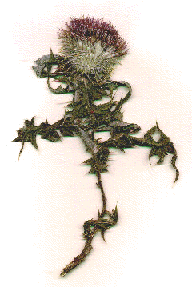
| A. The flower involved was a thistle.
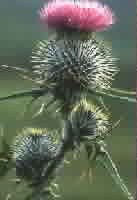
The thistle is the national flower of Scotland. The images show a "live" thistle
(top) and a dried and pressed thistle (right). When young Murron gave William the thistle, in addition to the straighforward gesture of sympathy and affection, she was symbolically placing the future of Scotland in his charge. The Scots thistle is a fairly prickly plant, and it would be difficult to pick with little fingers without bloodshed. The thistle which is seen being picked in the movie looks like a specially manufactured "safe" one. Thistles grow wild in Scotland and flower in August and September. See our thistle competition in 1996. |
 |
Cheri Bonney ...
| Q. I am a huge Braveheart fan, I've seen the movies several time...but cannot
remember the character who played Hamish's name. Do you know this? Do you also have any
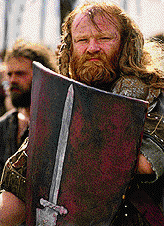
information about this person? Thanks so much! A. Brendan Gleeson played Hamish (as an adult) in Braveheart. Brendan is an Irish actor, playwright, and musician. He lives near Dublin and has appeared in movies such as Into the West and Michael Collins. |
 |
SGTLAZ ...
Q. hi. braveheart was easily my favorite movie. I 've taken up the bagpipe because of it. I was wondering if there were any mailing lists or something you could get me on to.
Jon Land ...
Q. Hi there, nice to see all the info on Wallace, I've a student who would like to know where Wallace is buried? Can you help?
A. After Wallace's execution his head was displayed on a pole on London Bridge, and his body was quartered. One quarter was exhibited above the common sewer at Newcastle-upon-tyne, another at Berwick-upon-Tweed, and another at Perth. Their is some doubt about the destination of the fouth quarter, with sources naming either Stirling or Aberdeen.
There is no record of what was subsequently done with these remains. A local tale from the Stirling area tells of the monks of the nearby Cambuskenneth Abbey salvaging Wallace's arm from beside Stirling Bridge, and burying it in consecrated ground. Legend has it that his left arm is buried with his finger pointing towards the Abbey Craig, from where he achieved his greatest victory on 11th September, 1297.
| Scott Robert Ladd ... Q. I hope you
can answer two questions for me: A. See Bruce's heart still in Edinburgh (latest update 19th February, 1998). Most of the battlefield site at Bannockburn is now covered with roads and housing (in the background on the photo on the right). The visitor centre, battle memorial, and Bruce statue are on a mound that Bruce is supposed to have used as his command post during the battle. |
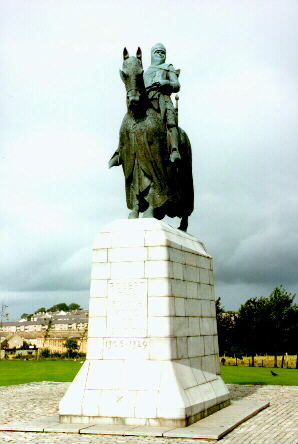 Photo courtesy of Susan Hodges |
Patrick ...
Q.
Dear Mr. and Mrs. Anderson,
My name is Patrick and I am from TX. I have seen Braveheart so many times I have lost
count. I watched it three times in a row when I got it on Christmas Day. I know that I
have not kept up with the other fans of this movie but I plan on watching it until my tape
runs out. I have a very IMPORTANT QUESTION. Where can I find/buy an uncut version of
Braveheart??
Is there even a director's cut that I could buy?? I would appreciate any information that
you could send me on this topic. thanks again!!!
Patrick
Annmarie ...
Q. You're Braveheart site is amazing, i absolutely love it. Could you please
place my name on the list to receive the newletter, I must have it.
Also, I have a question for the Braveheart Q&A.
Does anyone have information on the scene when Wallace and Murron get married and they
wrap their hands together? I know that it is a Celtic pagan ritual, but I need to know
more.
Ander Henderson ...
Q. does any one know why braveheart makes Bruce look so bad. in truth he
was one of Scotlands greatest heros (i do admit he did lick edwards boots for a while but
he got over that way before sterling bridge or even falkirk. he actuly had some 700 horse
there and helped Wallace out.
A. The movie Braveheart was primarily a work of drama, rather than a historical document. The Bruce appears to come out badly from the way he is presented in the movie, but he gets there in the end (at Bannockburn). The characters of Bruce and his father are very important in the movie to show the way the 'nobles' in Scotland were thinking and acting, and to show someone we can relate to (The Bruce) in a dilemma (in contrast to Wallace's uncompromising approach) which he would ultimately resolve for himself by risking all for Scotland after Wallace's death.
Marie-Andre Crothers ...
Q. Dear authors of a truly great Braveheart site:
How did Mr. Gibson film the torture scenes? They were just too realistic.
Thanks a lot,
Marie-Andrée Crothers, Canada
A. We seem to remember Mel joking in one interview that it was possible, with good direction and filming, to even make 'hanging, drawing and quartering' look 'pretty'. We don't have technical details of how the hanging etc. was carried out in a non-fatal way, but maybe someone who knows could get in touch.
Jonathan Zang ...
Q. I was wondering if you knew of anywhere to get BH wallpaper and screensavers?? Thanx Jon
Jerry Thomas ...
Q. Didn't Scotsman Sir Walter Scott write an extensive "history of Scotland"?
Francesco Lazzaro ...
Q. I have the integral scripts of the film; Sorry for my English, I hope
you'll understand anyway...
What does the father of William tell him after dying: "Your heart is free have the
courage to follow it!" or ..."to follow her?!"
Thanks
A. Have the courage to follow it!
Amy Shaw ...
Q. I have seen
Braveheart about 12 times, but I am anticipating seeing it much more in the next 2 weeks
as I have a project on Braveheart due on May 12. I am in a Film class at the University of
New Hampshire and as I already have an interest in Scottish history (my family is very
Scottish) I have decided to concentrate on comparing the movie to the real history. The
only problem is, our school library is under construction and they have none of the books
I need. Could anyone help me find a book I might be able to get at the public library or
local bookstore. I tried to order the book by James Mackay, but it was unavailable.
Thanks very much
Ange Parkin ...
A. In response to Amy Shaw's inquery on where to get Scottish history info. I spent 3 months researching Scotland's history and found that if you have a low budget library like I do, then the best place to get info is encyclopedias(esp. World Book '97 and any really old encyc. you can get your hands on. I know the info's really dated but they taught me so much more about Scotland!!) I hope that sort of helped you out.
Utauno ...
Q. Do you know where I might be able to find interviews of the actors and actresses of Braveheart in text form? Thanks.
Jeremiah J. Henn ...
Q. Who played Robert the Bruce's father? I thought that Mel Gibson played that part but I couldn't tell in the credits. Do you know??
A. Ian Bannen played The Bruce's father in Braveheart (see our BH credits see also his message to the 1997 Braveheart Convention).
Laura Paulsel ...
Q. I very much enjoy your page about Braveheart; it is a beautiful film about
the search for freedom. I love viewing it even more each time, and I believe the
soundtrack contains my favorite music of all time.
My question is this: I understand that Scotland won its freedom in the year 1314 after the
battle of Bannockburn, but when did the country
return to English rule? Is it now, as I understand, part of the United Kingdom and under
the rule of the British monarch? Is it also true that Queen Elizabeth was born at Balmoral
castle and still vacations there?
My only complaint about the film is the sensationalism employed in joining Wallace with
the Princess. In truth, Isabella did not marry the Prince of Wales until some years after
the death of Wallace, and their tryst seemed to add nothing to the film. In fact, it made
Wallace appear to dishonor the memory of his fallen wife--the very reason he continued to
fight. Any reason you know of as to why this was included?
A. Although Scotland won a
major victory at Bannockburn in 1314, King Robert the
Bruce and his supporters had to fight on for another 14 years until 1328 to achieve a
satisfactory peace treaty with England (where England renounced its claim to rule
Scotland). In later centuries there was first a union of the crowns and then, in 1707, a
union of the parliaments, creating the present 'United Kingdom'. Queen Elizabeth certainly
vacations at Balmoral, we don't know whether she was born there.
The princess character was introduced for dramatic reasons, for example to react to
Longshanks's discussions in the scenes in the palace in London. Having introduced the
character for good dramatic reasons, and then having her act as a link between the Wallace
and Longshanks characters, it is understandable that the romance and tryst would have then
seemed like a logical extension of this treatment of the Wallace story [trying to read
Randall Wallace's mind here :-) ].
D M Behnken ...
Q. SEVERAL VIEWINGS LATER, I REMAIN IN AWE OF THE POWER OF BRAVEHEART. I BELIEVE THE FILM DEMONSTRATES ART'S FULL POTENTIALITY AS AN AGENT FOR THE EXPANSION OF CONSCIOUSNESS: SPIRITUAL, SOCIAL AND POLITICAL; FOR HERE WE ARE, OUR FORGOTTEN HUNGER FOR REAL FREEDOM REAWAKENED. FROM A PURELY HEDONISTIC PERSPECTIVE, THE FILM IS GORGEOUS: PURE UNADULTERATED VISUAL PLEASURE. (HOW COULD SUCH BLOODSHED BE SO AESTHETICALLY MOVING? HOW DID GIBSON PULL THAT ONE OFF?)
HOWEVER ...
AS A GAY WOMAN (INCIDENTALLY OF IRISH/SCOTTISH DESCENT), I MUST TAKE ISSUE WITH THE
CONFLATION, INTENTIONAL OR NOT, OF THE HISTORICAL FACT OF EDWARD II'S HOMOSEXUALITY AND
HIS PORTRAYAL AS A SELF-ABSORBED, TWIT; I.E. NOT ALL SELF-ABSORBED TWITS ARE HOMOSEXUAL
AND NOT ALL HOMOSEXUALS ARE SELF-ABSORBED TWITS. THATS THE MAIN THRUST OF MY POINT.
ADDITIONALLY, I FIND NOTHING ESPECIALLY TRAGIC IN THE CLASSICAL SENSE ABOUT THE EXECUTION
OF EDWARD, AS A POLITICAL RIVAL, HE WAS FAIR GAME. BUT ITS MANNER, APART FROM BEING
"BEYOND" CRUEL, WAS CLEARLY DIRECTED AT HIS HOMOSEXUALITY AND THIS APPALLS AND
SADDENS ME.
PLEASE FORGIVE THE APPARENT ANTAGONISM OF THIS QUESTION WHICH IS OFFERED IN ALL SINCERITY. IS THERE ANY HISTORICAL DATA TO SUGGEST THAT EDWARD II WAS TRULY THE SPINELESS, SELF-ABSORBED IDIOT AS PORTRAYED; OR, WAS THAT GIBSON'S TAKE ON "THE HOMOSEXUAL PRINCE" I.E., HE WAS GAY SO HE MUST HAVE BEEN EFFEMINATE, SPINELESS ETC.
THANKS IN ADVANCE FOR YOUR KIND CONSIDERATION OF MY QUESTION
J E Hawcroft ...
A. I have never seen any outright reference
to Edward II being a homosexual, which considering the status of homosexuality in medieval
England doesn't mean he was or he wasn't. I have seen plenty of historians, however, who
indeed consider Edward II to be a complete wimp. This wasn't shown in Braveheart, but
Princess Isobel took a lover (Mortimer someone or other, I think) shortly after Edward I's
death, and she and Mortimer chucked Edward II off the throne, ruled in his place and
basically pushed him around. Also Edward II's battle record against the Bruce isn't very
impressive, the Scots chased
him all the way from Edinburgh to York once and history records that Edward lost all his
luggage in the process. It's little details like this that give him the prat-like image.
I agree that it's a shame that the only possibly gay figure in the film is such a berk
(although Edward's "lover" Philip seems OK). However it would be equally biased
to say that gay people aren't as likely as straight people to be idiots sometimes.
Regards, Jennie
Ray Cartwright ...
Q. Wow! I just
saw Braveheart for the first time on Cinemax. It was awesome. However, I must be a little
weird...even though I thought the battle scenes were impressive, I loved the scene when
the Scottish bride (Julie Austin) calmed the fighting and then whispered something to her
husband. Gosh that scene is incredible. Who is this Julie Austin?
If anyone can give me more information about her (age, hometown, previous works, married,
etc) I would appreciate it.
Caroline Edingburg ...
Q. I have a
question about the movie and actual history. I have just started doing some research on
William Wallace and Scottish history and nowhere does it say anything about his wife and
the reason he lost it was because they killed his wife. Was that true did they actually
kill his wife? What is the actual story behind that and how acurate was the movies
portrayal as far as his wife was concerned? Thanks for any info.
Mel Gibson is my favorite actor of all time and he was the only one who could have done
this...he was perfect! This movie has stirred such a yearning in me to not only research
Scotland's history but to go there and I find it ironic that my last name is Edingburg!
Thank you for any information that you can give.
A. Regarding the events of May 1297, the
following is from chapter 3 of Andrew Fisher's 1986 book 'William Wallace':
'Wallace had become a magnet for the discontented. He had recently married a young
woman who lived in Lanark. Visiting her by stealth, as a marked man, he clashed with an
English patrol. Fighting his way clear, he retreated to her house and as the pursuers
hammered on the front door he escaped by the back to the rocky Cartland Crags. Enraged by
the failure to capture him, Sir William Heselrig, Sheriff of Lanark, ordered the house to
be burned and all within it., wife and servants, to be out to the sword. From that day
Wallace vowed an undying vengance against the English.'
'Gathering together a band of desperate men, he fell by night upon the sheriff and his
armed guard, hewed the sherrif into small pieces with his own sword and burned the
buildings and those within them.'
Murron ...
Q. Greetings!
My name is Murron ;) and I'm a die-hard Braveheart fan...
I can't help feeling so jealous when I read about the 700th aniversary of Stirling. (I
live in southern CA, USA unfortunatly). I have one question, though... I thought that the
battle of Stirling Bridge was fought on JUNE 17,
1297, not September 11... I guess I was wrong... was I? What happened on June 17?
I wish I could join you in Scotland... I'd really give anything to go. I will be in London
this June (around the 17th) and I thought I'd maybe get to see some partying there, but
now I suppose I won't get to. :( Well, your
page is really good... thanks for all your helpful info. :)
~Murron~
A.
The Battle of Bannockburn
was fought on the 23rd and 24th June, 1314. The English army under Percy and Clifford had
moved into Scotland (to put down rebellion) in June 1297, and by the end of that month
were at Ayr.
We can't think of an anniversary on 17th June. If anyone else can, please let us know.
There will be a programme of events to mark the 700th anniversary taking place throughout
the summer in Stirling, so maybe you can get to some partying after all. We'll publish
details of these events in MacBRAVEHEART when they are available (next
month we think).
Christopher Hamilton ...
Q. My Name is
Christopher Hamilton (mchagbe@hunterlink.net.au). I am from Australia, and would very much
like to visit the home land of Willam Wallace, to stand upon the ground that he once did.
Though this may never be the case, I type in the event that you might know if there are
any Australian conventions (or any thing of the type), of which you could tell me about,
so I can to celebrate
the 700th anniversary of such an inspiring battles to be fought and won.
THANK YOU Christopher
Sarah Wallin ...
Q. I have a quick question, and I think you might be able to help me out in this area. I have a friend who is really upset because his cool Braveheart poster recently got stolen. He doesn't really know where to look, and I want to help him out. Do you know of any good places where I can send in and maybe get a replacement poster or something? Any input you could give me on this matter would be greatly appreciated!!!
A.Try:
Innervisions, 4548 University Way NE, Seattle, WA 98105
(206) 634-2392 innervns@halcyon.com
Andy Holak ...
Q. I have heard that an epic movie about Robert the Bruce is in production. I'm not sure where I heard it, but can anyone out there substantiate this rumor? I would love to see a movie about Robert the Bruce. I've done some research since seeing Braveheart, and it appears that Robert the Bruce did more to free Scotland than even William Wallace. From some accounts I've read, the Bruce was an absolutely brilliant srategist, and also made forays into England. One account I read had the Bruce's men scaling the walls of a cliff to attack a castle(can't remember which one). It would make an exciting movie!
A. The movie 'The Bruce' is available in the
UK to hire or buy. It was made on a low budget during 1995, and it shows. Anyone who has
seen Braveheart and is expecting a similar experience will be
very disappointed. We couldn't really recommend it.
The Bruce story would indeed make a tremendous
movie or TV series. We strongly recommend reading the 'Bruce' trilogy by Nigel Tranter
(ISBN 0 340 37186 2).
Marian Sampson's reponse to Andy's question re the Bruce movie:
There is a film about Robert the Bruce which stars, among others, Oliver
Reed. Save your money. It is bloody awful & doesn't even come close to reality. As
soon as I remember where I threw it, I'll get back to you with more details. Meanwhile, if
you want a really good bio of the Bruce, get Ronald McNair Scott's book. It is so-o-o
good.
P.S. Loved Braveheart, & watch my copy over & over, but it is not exactly factual,
either, though it comes closer than most that Hollywood produces.
Karen King ...
Q. I am interested in knowing where I can read the original legends of William Wallace and of his time in Scottish history. In my opinion, there are three Braveheart stories: 1. the original story, 2. the legends that grew up around the original story, and then 3. the Hollywood version of the legend. Any suggestions where I can look to help sort these out?
A.
We suggest you read the books:
William Wallace - Brave Heart by James Mackay
The Wallace by Nigel Tranter
to begin with. J & L.
Shawn ...
Q. I have a repro
of the actual sword used in the movie. The only company that is authorised to make the
exact sword is a company named The Noble Collection. Ph#1-800-866-2538.
I do have a question however, are you aware of anyone that makes a repro of Wallace's
actual sword? The one that is kept in the Wallace National Monument in Stirling? I have
been searching and searching, including recruiting employees from the monument.
Thank you in advance for your help,
-Shawn-
[ NOTE! The validity of the above phone number has been queried. We're checking it. ]
Warren ...
Q. Hi...I have been searching for a Braveheart screensaver for ages...was wondering if you knew of one that was out there and available to download. Thanks for your help.
Patrik ...
Q. hello my name
is patrik I want to ask about the length of the braveheart film I read that mel gibson
cutted down the movie 1 hour I have the film on laserdisc and i have probably seen the
film 20 times and i want to see the rest do you know if braveheart are gonna be realeased
in directors cut and if so when i hope you can help me thank you
A. We believe that Mel said that although he cut some
of the violent shots out of the battle scenes, he did not feel that this harmed the
overall effect of the movie. He said that the movie as released was 'the Director's cut'.
J&L
Sheldon Martin ...
Q. I figure you
have the soundtrack to braveheart so I wantd to ask a question. In the movie there are
more musical scores than on the soundtrack. Why is this? Did the makers of the album make
another version with all the scores on them.
Just to let you know, I finally was able to buy the movie. I bought the widescreen version
so its as good as in the theatre.
If possible, I am going to try to dress as William Wallace to go the school and the dance
on Haloween. If I do, I will get a picture taken and put it on my Web page.
[We hadn't noticed any significant difference between our soundtrack CD and the music on
our video (other than missing out the wedding music). We don't know of any longer CD
version. We look forward to seeing the Halloween picture.
Terry Sarros ...
Q. Hi,
My name is Terry Sarros, I just have a quick question for you. Do you know of any place
that I can get leather armor like what was used in Braveheart (the best movie ever)? I
have check every place I can think of and no-one has any ideas, can you help? Thank you
for your time.
A. We suggest you try contacting Chic Allan by mail or
by telephone at:
Clan Centre and
Braveheart Trading Post
189 Canongate
Royal Mile
Edinburgh
Scotland
Telephone +44 (0) 131 558 9191 or +44 (0) 131 558 9393
Chic sells some leather accessories e.g. sword pouches, armlets etc.
He also has the leather armour himself which he wears as part of his daily costume, so he
should either be selling it or know where you could get it. J&L
loracsa ...
Q. Andersons -- Thanks for a wonderful web page! Do you/does anyone know where to find information on David O'Hara (Stephen)? Thanks!
Graham St. John ...
Q. Hello again, I
have a question you can hopefully answer. I have been pondering over the last couple lines
in Braveheart.
In the year of our lord 1314, patriots of Scotland, Starving and outnumbered, charged the
fields of bannokburn. They fought like warrior poets. They fought like Scotsmen and won
their freedom.
Now unless i've been totally misled, am I not correct in saying that the Scots were
slaughtered at the battle of Bannockburn?
A women on your appeal page said something like Robert
The Bruce picked up where Sir William Wallace left off and led Scotland to freedom.
You had not reply to her letter so I'm not sure if she is right or not.
I am a third generation American but before that, both my mothers and my fathers sides of
my family came from Scotland. I wish i knew more about scottish history. I have spent many
hours recentally talking to my Grandparents asking about the history of our Clan and the
history of Scotland.
A. It was definitely the English army which got slaughtered at Bannockburn Graham. It is generally accepted that the terrible way Wallace was executed by Edward I in 1305 was one of the factors which drove The Bruce to wage a lengthy campaign to free Scotland, leading to the great military victory at Bannockburn. It then took Bruce further years of struggle until 1328 when a treaty with England finally recognised that Scotland was free.
Marc A. McEachern ...
Q. Do you know of anywhere I can obtain win95 Braveheart Themes? I'd be greatful for any information. thanks...
A.
Answer from Tom Crosby (24th December, 1996):
Hi,
I have an answer to a question written by Marc A. McEachern. To obtain a Windows 95
Braveheart theme, check out http://www.aloha.net/%7Ebrvhrt/
The file is near the bottom of the page. Also, you have put together a very nice page, I
enjoyed visiting it.
David C. Cole ...
Q. I love your web page! I have seen Braveheart 5 times and have loved it every time. My question is, how did the wimpy Prince die? I've heard that the soon-to-be queen killed him to take sole posession of the throne. I've also heard the way she did it was quite interesting. Please excuse my vagueness. My Scottish history is very poor.
Thank you,
David C. Cole
Vienna, VA
A.
Answer from Andrea Tomich:
I was looking over your MacBraveheart page (great job, by the way), and I found David C.
Cole's question of how Queen Isabella had King Edward II killed in your questions and
answers section. I have the answer to that question.
But first, in case it isn't known about, there is a Braveheart CD-ROM out by Midisoft
Entertainment. It's wonderful--I have it. It tells histories of all the main characters,
information about the movie, information about the Mideval Ages, and even has fun games
where the rewards are movie bloopers and behind-the-scene looks. GREAT fun. It runs on
Windows 3.1 and Windows 95, and there is a Mac version as well. I thought you may want to
let the fans know about it if they don't know already. A possible e-mail to write to to
ask about it is salesinfo@midisoft.com, or http://www.midisoft.com. If you need the address and
phone number, it's listed as well and I can send it to you.
But about Edward II. Isabella did indeed overthrow him to gain the throne. She fell in
love with Roger Mortimer from France and they captured Edward and his lover (yes, he
really was homosexual). They imprisoned Edward in Kenilworth Castle until the queen
decided what to do with him. They then moved him to Berkeley Castle in late summer of
1327. There he was steadly ignored until he was moved into a tiny cell. On Sept 21 he was
executed, and it was just as bad as David heard. "He was held down by two of his
executioners, while the third inserted a red-hot iron into Edward's rectum and thrust this
deadly implement deep into his bowels. This left no outward evidence of bodily harm but
the legend is that his once handsome face remained contorted into a grotesque grimace of
horror and pain." (Courtesy of Braveheart CD-ROM, Midisoft Entertainment, 1995.)
There's the answer to David's question--hope it helps! And I wouldn't even wish that death
on my worst enemy!
Joe Dwyer ...
Q. Do you have any recommended books on William Wallace. My searches show nothing on Randall Wallace. Thank you. Joe Dwyer
A. Please see the answer to Karen Kings's question.
Shelley ...
Q. Hi
During the wedding festivities after Wallace returns home as a man,Hamish challenges William to the boulder toss by saying he can crush William's skull like a "wuddom" (I tried to spell it like it sounded to me!) Please can anyone tell me what it is?
Regards!
Shelley
P.S. Your Web Site is my FAVOURITE!!
A. Hamish said that he would crush William 'like a worm'.
Mathias Kohring ...
Q. I have one question regarding the sword in the movie. I have seen the picture of Wallace's sword on display in Stirling, and it is obviously not the same one used in the movie. Still, I have heard that the sword in the movie IS an actual replica of Wallace's sword. I know I am being nit-picky, but is the sword in the movie accurate or not?
By the way, I have only seen the movie four times, and it becomes more vivid and moving each time. Thank you for a wonderful www page on such an important figure.
A. We’ve seen the sword ‘in the flesh’ so to speak. I think the sword in the film was a reasonable replica. It certainly looks approximately the same shape. Historically its difficult to establish whether the sword in Stirling is the Wallace sword. I’d be delighted to receive any information on its path from Wallace to its resting place now. However all accounts of Wallace suggest he was very tall, about six feet six inches. The sword was 66inches, the blade 52inches and forged in Scotland. I can’t imagine Mel could have swung such a length of sword. Apparently James IV ordered the sword to be rehilted in 1505. In 1937 it was stolen from the memorial and recovered some time later in a house in North West Scotland. The stone of destiny on which Scottish kings were crowned was removed from Scone by Longshanks. However there is some suggestion in historical references that he removed the wrong stone and the true one was hidden. He certainly removed just about everything to do with the history of Scotland, in order to wipe out its history as a realm (Scotland was the oldest known realm in Christendom). One last point; Scotland always had a King of Scots (the people), where England had a King or Queen of England. This unique definition of sovereignty was alluded to in Wallace’s speech after his knighting. Nobles exist to give the people their freedom etc. (Robert the Bruce became King of Scots). Normally Kings were Kings of a country and the people merely the vassels on it.
Q. John and Linda,
Thank you for responding to my inquiry. I was curious about the nature of the sword because of some mismatched details. First of all, the sword in the movie appears to be a two handed broad sword with a spherical pommel. The crossguard is straight and about a foot of the blade wrapped in leather towards the handle. None of this seems apparent in the picture of the sword at Stirling. It appears to be a regular broadsword with a different pommel and no leather on the blade at all. When James IV had the sword rehilted, the design might have changed. As a matter of fact, the sword in the picture doesn't seem like anything special at all. I suppose one has to see it in the flesh ( so to speak) to appreciate the actual size of this weapon.
I hate to be so picky, but when filmakers claim to be as accurate as possible, I like to think I am seeing the real thing. I find the details about the sword's history and Scotland fascinating. Imagine the terror Wallace must have struck in the hearts of the English when he swung that mighty sword at them. It is too bad Scotland did not remain free.
Wallace had the right idea. Rulers serve to protect the people they rule. If only everyone could realize that this is common sense.
All my best,
-Mathias Kohring
A. The sword in our picture taken at the Stirling Wallace Monument page is a two-handed sword of about 5ft long, and it looks like it would take small giant to wield it. We think they must have decided that they wanted a more 'basic' look for the sword for the movie, and put together their own design. The overall length would be about the same, though if one is bigger, we think it would be the one in the Monument.
Sheldon Martin ...
Q. I was wondering how historicaly accurate is the movie on Wallace's life. How long did it actualy take to film the movie.
A. Answer to Shelmart@computime.bc.ca, it took two years to make Braveheart, Mr. Gibson had to do a lot of research to make it as accurate as possible, he did a marvelous job, agree? - Bonnie Bell 19th June, 1996
Linda 101733.252@compuserve.com ...
Q. Anyone from Scotland, please E-Mail me if you heard of celebrations during and after the Academy Awards ceremony as Mel mentioned that Glasgow was partying hard. Also, what did Scottish papers say on Bravehearts victory. Would love to know. Also, does anyone know of a book about Braveheart on how the film was made etc.
 |
 |
 |